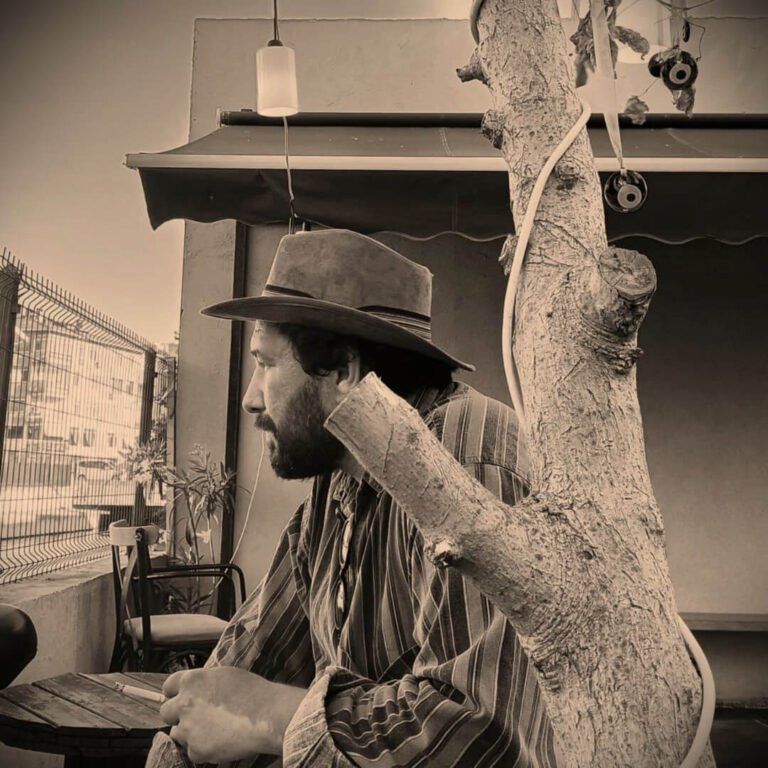
I first discovered Eric Christian von Fricken’s music in 2018 through Le Mal du Pays. Some pieces you listen to, fall in love with, and eventually move on from as other music enters your life. Others can take you back to the very same place with just their first few notes, even years later. Le Mal du Pays has always been the latter for me. I remember listening to it over and over again for days, even weeks. And when I play it today, it still evokes the same curious combination of serenity and an almost indescribable sadness.
Perhaps this is precisely where the power of Eric Christian’s music lies. Without allowing melancholy to become darkness or romance to dissolve into mere nostalgia, his music creates a space where, within just a few notes, longing can turn into serenity, vulnerability into reverie. Un rêve, Le Rêveur, Dans le noir, Lettres d’amour, La Valse au Clair de Lune… His compositions carry echoes of the Romantic tradition, yet possess a melodic language distinctly his own one that can often be recognised within just a few notes.
And this world extends far beyond music. Photography, cities, light and shadow, old scores, candlelight, a piano accompanied by a glass of wine or champagne… Christian has created an almost cinematic universe around his music. His relationship with the past also runs deeper than aesthetics: his family lineage traces back to Ernestine von Fricken, to whom Robert Schumann was once engaged.
His Spotify bio still carries a single sentence:
“All I want is to write music that makes people cry.”
For a composer who first captivated me with Le Mal du Pays in 2018 — and who can still make me feel the same way when I return to that piece years later, it is difficult to imagine a more fitting statement.
Now, Eric Christian von Fricken is preparing to meet his audience in Istanbul with his first performance in Türkiye at Zorlu PSM on October 1. After years of listening to these melodies through our headphones, in our homes, and within the private landscapes of our own stories, we are eagerly counting down the days until we can finally experience them live in Istanbul.
Ahead of the concert, we spoke with Eric Christian von Fricken about the memory of music, longing, the Romantic tradition, his relationship with the great composers of the past, photography, creative rituals and, of course, Istanbul.

I first discovered your music in 2018 through Le Mal du Pays, and I remember listening to it over and over again for days, even weeks. Even today, its first few notes can immediately bring back the same feeling. There is something in your music that is both deeply soothing and capable of awakening a kind of longing that is difficult to put into words. Do you think a melody can make us long for something we have never actually experienced?
Of course. There is the famous quote, “Where words end, music begins.” Music has the power to make us feel things we cannot even understand. That’s what inspired me to become a composer. With it comes extraordinary power.
A melody can change the world.
Your Spotify bio still reads, “All I want is to write music that makes people cry.” And your music does seem to have a remarkably powerful emotional effect on listeners. When you compose, do you already know what you want the listener to feel, or do you sometimes discover the emotion a piece carries only after it is complete?
Usually, I always have an idea. I always wished to be a film composer. I find it easier to compose when you have a visual cue of what you are trying to translate. So when I started composing for myself, I would just imagine scenes that didn’t exist and try to translate those emotions.
Having listened to your work for many years, Le Mal du Pays, Un rêve, Le Rêveur and so many others — I feel there is a distinctive melodic language that can make me think, within just a few notes, “This is Eric Christian.” How would you describe your own musical signature? Does a composer consciously search for their own voice, or is it something that gradually reveals itself over time?
It took me a long time to find my voice. For a long time, I wondered if I would ever find it. I think much of it came over time from understanding who I really was.
Finding your identity, but also having the patience to wait until you really have something to say.
There is another famous quote by F. Scott Fitzgerald: “You don’t write because you want to say something; you write because you have something to say.”
Santé à Chopin, your Impromptu written for Schubert, and Scenes from Paris, which was inspired by Schumann’s Scenes from Childhood… The great composers of the past seem to exist in your music not merely as references, but almost as people with whom you are still in conversation. Do you see yourself as a composer carrying the Romantic tradition into the contemporary world? And what kind of musical relationship do you have with Chopin in particular?
Of course. All of this comes from my love of classical music. All of my inspiration comes from them.
Of course I love Chopin, but the composer who is most responsible for my existence is Erik Satie.
I looked at Chopin like a God; I did not understand him for a long time. Erik Satie I could relate to. I remember one summer many years ago studying his music — simple and beautiful, and yet perfect. Creating such a magical atmosphere and immediately gripping the listener.
I thought to myself how wonderful it would be to spend a life writing little piano pieces like this and imagine if people actually cared.
Fifteen years later, I’m doing exactly that.
There is also a fascinating parallel within your own family history: your lineage traces back to Ernestine von Fricken, to whom Robert Schumann was once engaged. Considering your own relationship with Romantic music today, it feels almost like a poetic coincidence. How do you perceive that connection? Does it give you a sense of musical inheritance, or is it simply a beautiful detail in your family history?
I love history. It’s just a little fun fact I discovered later in life.
I like to think that it means I’m exactly in the place I belong. That my family name was always supposed to be associated with music.
They were one and the same.
There is also a very distinctive visual world surrounding your music: light and shadow, old scores, cities, candles, the piano… Your photography seems to carry a similarly cinematic sensibility. When a composition first appears in your mind, does it exist purely as sound, or does it also have an image, a particular light, perhaps even a place? Has a photograph ever become music for you or a melody become a photograph?
When I was in college, I had never really been anywhere, and I found it very hard to try and compose anything. We took many trips to the Museum of Fine Arts in Boston. My first idea for composition was to compose my favorite paintings in the museum.
One of my first ideas was about this ship on a stormy sea that I loved. That was the first real melody I ever wrote and really liked.
I would play it on loop over and over, but I never finished the piece. I still didn’t know how back then.
A glass of wine or champagne often seems to find its way beside the piano in your posts and, of course, you even have a composition titled I Love You When I Drink Champagne. Wine, candlelight, the piano, old scores… they have almost become little rituals within the Eric Christian universe. Do these things genuinely play a role in your creative process, or is there simply an incurable romantic behind all of it?
Of course. Aesthetic is very important. And if you go back in time, almost all the composers did the same. Liszt loved his wine and champagne. Ian Fleming did the same while writing James Bond.
I think it’s a unique aspect of what we get to do for our “work.” The fact that we get to enjoy and make pleasure of our writing. Very few people are allowed to indulge in this way.
It’s part of enjoying life, but also having a purpose and creating something.
The atmosphere means everything. Candles, shadows, champagne, even the way I dress to be alone at home has something to do with it.
It’s sacred.
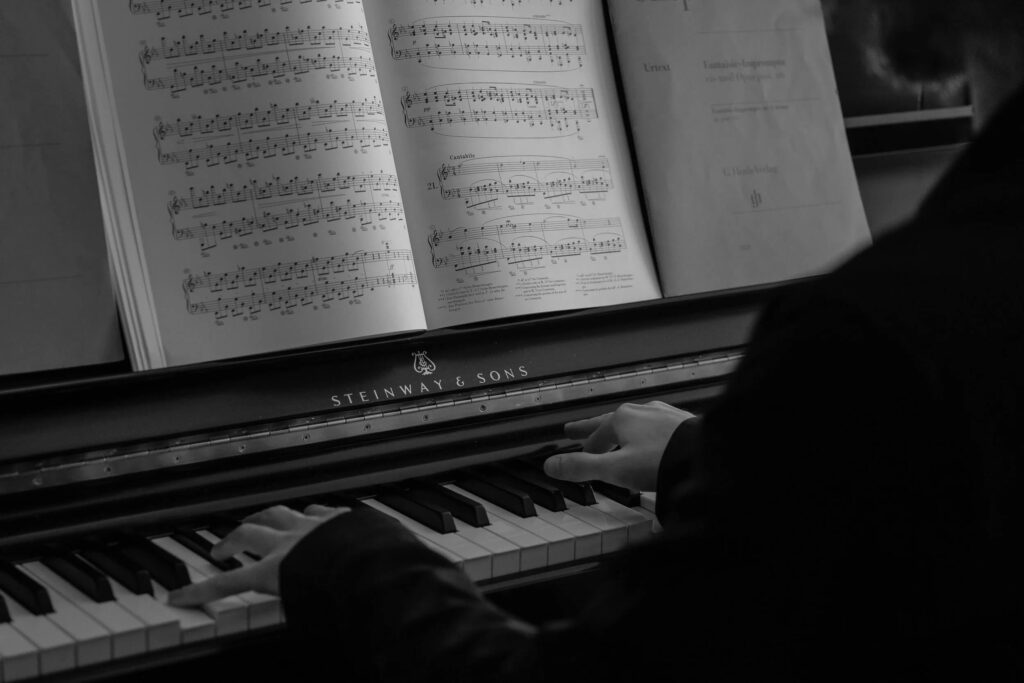
You sometimes return to your compositions years later — Un rêve with its seventh-anniversary edition, or Menuet being reimagined, for example. Do you believe a composition is ever truly “finished”? When you return to an older piece years later, do you feel that it is the music that has changed, or that you have?
I don’t think anything is ever truly finished. As with all art, there could always be one more brushstroke.
Many pieces I publish knowing they aren’t finished. They are as good as I can get them for that time in my life. But as I grow and learn more, they may also grow with me.
Menuet was the same for eight years. Then suddenly, one day, I realized it needed an intro and outro that connected it all. It’s still not finished, but I think it’s closer now.
There are endless possibilities with music.
And now, you are about to perform in Istanbul for the very first time. How does it feel to be coming to Istanbul, and what kind of image or curiosity does the city evoke in your mind? What does it mean to you to finally share the same room, on October 1, with listeners in Istanbul who have been experiencing your music from afar for years?
To be honest, it almost doesn’t feel real. Like a dream.
When I first released music eight years ago, the only listeners I had were all from Istanbul. It was my entire Spotify audience. I don’t know how or why, but that’s what it was.
If it wasn’t for the people in Istanbul, I don’t think I would exist as a musician.
I said long ago that if I ever performed publicly, I would start in the place that gave me my beginning. I hope this is the beginning of a very special relationship.
My first public performance with my own music — and a place I hope to return to for the rest of my life.
I am so incredibly thankful to the people there and can’t wait to return soon.
Yakında görüşürüz, Istanbul.