A Conversation with Grimanesa Amorós: In Pursuit of Light
Bu söyleşiyi Türkçe okumak ister misiniz? Türkçe versiyon için buraya tıklayın.
Light, for Grimanesa Amorós, is not merely a material; it is a way of thinking that transforms space, memory, and the viewer’s perception. The Peruvian-born American artist draws international attention with large-scale light installations that redefine both physical and conceptual boundaries through her use of LED technology, fiber-optic structures, and architectural surfaces. In Amorós’s work, light becomes a sensory flow that interacts with architecture and forms a bridge between rhythm, movement, and collective memory.
Her latest project in Istanbul was realized as part of The Peninsula Istanbul’s “Art in Resonance” program. Among the new installations included in the program for the 20th anniversary of Contemporary Istanbul, Passage will continue to meet viewers throughout the year, bringing together the hotel’s historic façade with a contemporary light language. Another work featured in the program, Maritime, is conceived as a suspended installation in the hotel’s lobby and offers an abstract reference to Istanbul’s maritime heritage.
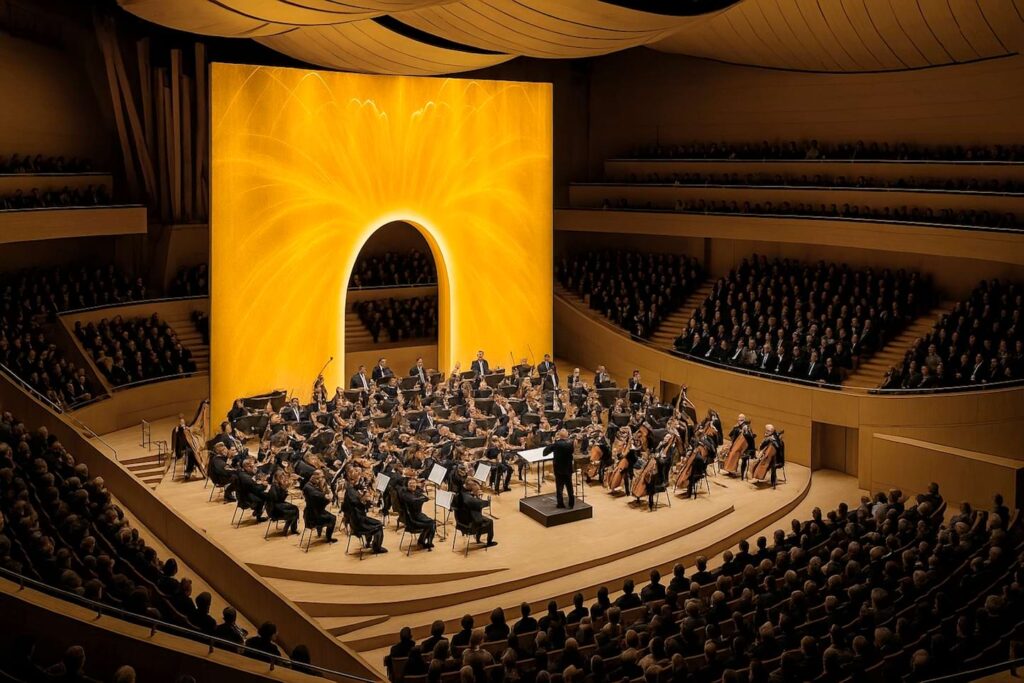
Another recent project by Amorós is RADIANCE, created for the Los Angeles Philharmonic’s January concert. Inspired by the element of fire, this monumental light sculpture establishes a strong sensory connection between music and light, drawing from Scriabin’s Prometheus: The Poem of Fire, Op. 60 (1910).

Across her recent projects in Istanbul and Los Angeles, a shared approach becomes evident: the power of light to reveal the cultural layers of a place and to create new experiential spaces for audiences. With these two new works in mind, we invite you to read our conversation on her artistic philosophy, her dialogue with space and technology, and the role of light in contemporary art.
Light is ephemeral; what I love is that it cannot be owned, yet it can bring people together.
Grimanesa Amorós
You created a light installation for The Peninsula Istanbul. In a city where rich historical architecture coexists with contemporary forms, how did Istanbul’s architectural and cultural layers influence the form and rhythm of Passage?
This work is inspired by the Bosphorus and the importance of its role in history, but also for Istanbul citizens. Proudly being a natural strait that connects East to West, a location of power and pride. The reason there are two works, MARITIME, being inside, and PASSAGE being outdoors is to emphasize the two most important areas in a ferry terminal, which is what was there before the Peninsula Hotel, the inside where passengers end their journey or begin or see loved ones or say bye, and outside, the clock that kept everyone on time, boats sailing from to and frow to complete their routes.
Passage will remain on view until the January 2026, which means your work will accompany the site for an extended period. How does the relationship between an installation and its viewers evolve over time? How do you perceive the role of light as a living element that can leave a trace in the city’s memory, even if only temporarily?
For me, the most important element in all my artworks is making the viewer think. I explore how light can create connections between people, architecture, the environment, and even within themselves. Light is ephemeral; what I love is that it cannot be owned, yet it can bring people together. Each lighting sequence and sculpture creates a balance between the viewer, the space, and the artwork to become one.
While Passage is experienced on the exterior façade, Maritime presents an interior light composition. How do you position these two works in conceptual or emotional terms? In what ways do you interpret their unity or contrast? Within the context of Istanbul, what does this dual structure mean to you?
Time and water are two themes that continue to shape my work. Both are powerful forces that move through the world without boundaries. They cannot be contained, and yet they touch everything. In PASSAGE and MARITIME, I was thinking about how time and water connect people across geographies and histories. These works are not just visual lighting installations. They are landscapes that invite the viewer to slow down and become aware of their movement through space.
PASSAGE, I created a sense of transition and flow, something that speaks to the moments between where we were and where we are going. MARITIME draws on the deep and fluid memory of water, its rhythms, its vastness, and its capacity to hold stories. Both works are meant to evoke contemplation. I want viewers to enter a space that allows them to feel grounded and adrift at the same time. The experience becomes a way to connect with their surroundings and with something beyond themselves. Light allows me to express these sensations without requiring language.
RADIANCE, created for the LA Philharmonic, draws inspiration from the element of fire and Scriabin’s Prometheus: The Poem of Fire. In this interplay between music and light, do you think light becomes an expressive tool capable of expanding the emotional range of music?
Scriabin’s piece is unique with its focus on light and incorporating it into music in the first place. It will be fun to take the music and express it in my sculpture. Many compositions have been created inspired by seasons, like Antonio Vivaldi’s concerto, and light is a part of that; light affects the setting, how we see the world. In the dark, we see one thing, but light and the way a place is lit can affect experience. Hearing a string quartet in an outdoor amphitheater during the day versus at night with candles is two different immersions, although the music is heard in the same location, these are two different environments. Light provides a setting for music, and the two interplay. Light is a tool that weaves into the music, providing strength in moments of power and softness in moments of pianissimo.
The monumental scale of RADIANCE transforms the space into a kind of performance environment. When working at this scale, how do you consider the sensory impact that volume and spatial presence create for the viewer? What does the idea of an immersive light sculpture mean to you?
As I mentioned above, each lighting sequence and sculpture creates a balance between the viewer, the space, and the artwork to become one. Size can affect how it is perceived, but the focus is on the light and its sequence. The same goes for RADIANCE. For me, the most essential element is how the work will move you. I think about how light can connect people with architecture, with the surrounding space, and even with a part of themselves. Light is ephemeral. It’s not something you can touch, but you can feel its presence. I choose materials and colors based on how they interact with and respond to light. Voltage becomes part of the rhythm. It affects how the light breaths, how it flows or pauses, and how it creates peace. Every decision is made to support that experience of unity between the viewer, the space, and the work itself.
Your works often engage with notions of flow, transition, connection, and movement. Do you observe a conceptual parallel between Passage in Istanbul and your recent project in Los Angeles? Does the meaning of light shift for audiences in different cities?
My works share the same core language, so there is naturally a conceptual connectivity with PASSAGE in Istanbul and RADIANCE in Los Angeles. Even though the contexts are different, both pieces explore how light can guide people through a space. In Istanbul, the work reflects the movement of the Bosphorus and the constant transition between past and present. In Los Angeles, the rhythm of light responds to music, where RADIANCE merges light and space to create an experience that transcends the tale of Prometheus, the discoverer of mankind’s origins, and the Incan god Viracocha, the creator and giver of wisdom. Both godly figures symbolize working with illumination as a pursuit of knowledge and enlightenment.
Prometheus, a Titan, shared the gift of fire with humanity, sparking technological advancement and human progress. Viracocha bestowed knowledge upon his people, teaching them the arts and guiding them toward civilization. Both are otherworldly, and both are catalysts in the unification of humanity.
RADIANCE challenges boundaries and transforms its surroundings, positioning light as both a medium and a metaphor for connection and communal discovery. Both installations invite the viewer to slow down, to be present, and to experience themselves in relation to their surroundings.
As for audiences, I don’t think the meaning of light is fixed; it adapts to each city’s culture, pace, and spirit. In Istanbul, light becomes a bridge between histories and identities. In Los Angeles, it becomes a force of expression and performance. But at the core, the emotional encounter remains the same: if light can stop someone for a moment, if it can move them or make them aware of their own presence, then the work has fulfilled its purpose. Light may be interpreted differently in each place, but its ability to connect people to themselves and to each other is universal.
In your artistic practice, technology functions both as a creative material and as a mediator in your dialogue with space. In these two recent projects, what new challenges or technical solutions emerged? How do you maintain a balance between the technological and the poetic?
Technology has always been a tool in my practice. For PASSAGE, the challenge was building a lighting structure that could withstand outdoor conditions on the clock tower while still performing and sharing the rhythm. For RADIANCE, we developed a voltage-driven sequence to synchronize light with musical energy on a monumental scale.
For me, balancing the technological and the poetic comes down to intention. Technology is never the subject; it exists only to serve the movement & the sense of connection with the composed light. I spend as much time thinking about how light will move the viewer as I do about circuitry and materials. If the engineering is perfect but the light doesn’t move you, then the work is incomplete. When technology supports presence, silence, contemplation, and wonder, that’s when it becomes meaningful. My goal is to use technology to bring people back to themselves, not to overwhelm them.
Your biography includes extensive reading on architecture, urban memory, and public space. When working in two distinct cultural contexts such as Istanbul and Los Angeles, how do research, observation, and site-specific study shape your preparatory process? How do these investigations feed into your works?
Research and observation are fundamental to my process. Before I even begin sketching, I spend time understanding the location, its architecture, its history, the memories held in its public spaces, and the way people move through them. In Istanbul, that meant exploring a city shaped by layers of civilizations, where the past and present coexist visibly. In Los Angeles, the research turned toward performance, mythology, and the energy of cultural production. Each city has its own atmosphere, its own way of breathing, and I study that before I think about light.
These investigations don’t dictate the work literally; they shape the emotional architecture of the piece. I’m interested in the unseen relationships of spaces: what connects people to their environments, to each other, and to themselves. When I understand that connection, the lighting sequences begin to emerge. The research becomes intuition, and intuition becomes composition.
Ultimately, the installation becomes a conversation with its context. PASSAGE and RADIANCE came from two very different cultural landscapes, but the goal in both was the same: to create an experience that feels native to its site while also inviting the viewer inward. Site-specific study gives the work its grounding; light gives it its voice.
Could you tell us about the project that has influenced you the most so far?
That question feels a bit like being asked to choose a favorite child; every project is a part of me. Each one has taught me something, expanded my understanding of light, or shifted my perspective in some way. But if I had to name one that influenced me deeply, it would be the moment I saw the Northern Lights and decided not to take a picture, but just live the moment. It was the moment I realized that light could transform behavior, emotion, and presence. Since then, every work I create carries that lesson forward. Each installation feels like another step in an ongoing journey, and I am present in all of them from beginning to end.
Thank you for taking part in this interview. As a final question, is there an architectural structure anywhere in the world where you would like to create a work with your light-based practice?
A fantastic question, Alula, as I have always been drawn to deserts and am obsessed with them.